
The Franchising Code Won't Fix Franchising. Here's What Will.

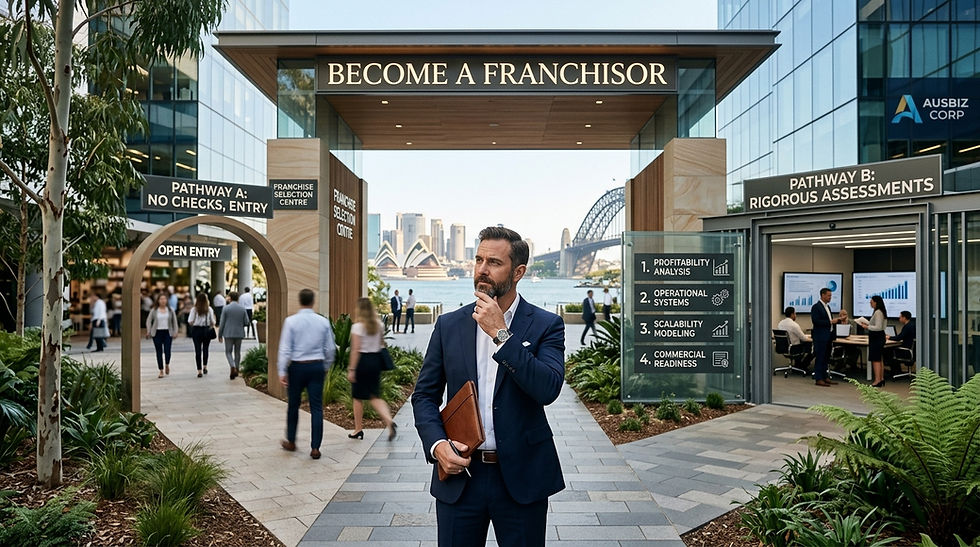
The ACCC wants more transparency in franchise recruitment. Jim Penman wants mandatory, published franchisee satisfaction surveys. Both are right, and both are treating symptoms.
The root cause of Australia's franchising problems isn't disclosure or reporting, it's that almost anyone can become a franchisor with no requirement to prove their business model actually works, and the consultants and lawyers who build the system around them carry no accountability for getting it wrong.
Two Respected Voices, One Missing Piece
ACCC Deputy Chair Mick Keogh recently called out the sales pressure and misunderstanding that surrounds franchise recruitment, pointing to cases like 7-Eleven where franchisees signed under urgency without grasping what they were actually buying, a fixed-term licence, not an appreciating asset. He's right, and it's worth the industry paying attention when the regulator says it out loud.
Jim Penman went further, publicly challenging the Prime Minister and calling the current Code "worse than useless." His proposed fix is a mandatory, independently run franchisee satisfaction survey, funded by franchisors and published for prospective buyers to see before they sign. Jim's Group has run its own version of this for years, and it's a genuinely useful idea. I know, because I worked under Jim at Jim's Group and saw exactly how that kind of transparency changes franchisee confidence.
But both proposals share the same blind spot. They improve what happens after someone becomes a franchisor. Neither one stops an unready, underfunded, or fundamentally unworkable business from becoming a franchisor in the first place.
The Real Problem Starts Before Day One
Here's what the Code, the ACCC's recommendations, and Penman's survey proposal all miss: There is currently no requirement, anywhere, for a franchisor to demonstrate that their business model can actually generate a fair, sustainable return for franchisor, franchisee, and staff simultaneously.
A business can be marginally profitable as a single owner-operated shop and catastrophically unprofitable the moment franchise fees, royalties, and marketing levies are layered on top. Nobody really checks this before the franchisor registers their franchise (if they actually bother to!) on the Franchise Disclosure Register and the first franchisee signs. The market eventually weeds out the failures, but by then it's the unsuspecting and possibly gullible early adopters who've absorbed the financial loss, and often the personal toll that comes with it.
I raised exactly this point in our submission to the Franchising Code exposure draft review: Franchisors are required to disclose their solvency, but never required to prove the underlying business is commercially viable enough to franchise at all.
I'm not saying business owners do this maliciously. They are either over-zealous in their desire to expand or prop up cash flow through franchise fees or they're just plain uneducated in what it takes to set up a franchise system. They are certainly not the only ones to blame.
The Supply Chain That Lets It Happen
This is where I'll say something most people in this industry won't. Franchise consultants and franchising lawyers carry real responsibility here too, and right now, they carry none of it.
And I say this from experience. Not only have I worked inside other franchising consultancies, but at Franchising Made Easy® we often see the so-called "fixer-uppers," the businesses who entered into an arrangement with another franchising consultant or bought a legal documents from a lawyer and exited that relationship much poorer and with a pile of paperwork but no robust franchise system.
A franchise consultant can take on any client willing to pay, regardless of whether the business has the profit margin, systems, or brand strength to support a franchise network. A lawyer can draft a fully compliant disclosure document and franchise agreement for a business that was never commercially ready to franchise, and face zero consequences when that system collapses under its own weight two or three years later.
Let's be even more specific. Disclosure documents verge on worthless. The ranges are so broad and the resultant financial clarity so nebulous, that the franchisee needs a degree in financial modelling to be able to work out if they will make a profit or not.
I've advocated for this before and, to my own regret, backed away from pushing it as hard as I should have. But the position stands: When a legal or consulting service provider builds the entire framework around a business without first confirming it has a viable commercial foundation, they are not neutral service providers. They are active contributors to the creation of what I'd call zombie franchisors, systems that are legally compliant and completely unable to sustainably support the franchisees inside them.
What Would Actually Fix This
Transparency after the fact and satisfaction surveys are worthwhile, but they don't stop the damage from happening. Two changes would.
First, mandatory franchise readiness or success criteria applied before registration, addressing unviable business models entering the market in the first place, with accountability sitting squarely on the franchisor.
Second, accountability standards for the consultants and lawyers who build the franchise system, addressing compliant paperwork built on unproven commercial foundations, with responsibility extended across the franchise supply chain rather than resting on the franchisor alone.
Mandatory success criteria, assessed against measurable commercial and operational benchmarks, would filter out businesses that simply aren't ready to franchise, before a single disclosure document is drafted. And holding consultants and lawyers accountable for the systems they help create would end the "garbage in, garbage out" dynamic that currently lets unscrupulous or simply unprepared franchisors reach market unchecked.
Where This Leaves The Industry
Keogh is right that recruitment needs more transparency. Penman is right that ongoing accountability through franchisee feedback matters. But neither addresses the moment that determines everything else: Whether a business should have been allowed to franchise in the first place.
Until readiness is tested before a franchise system is built, and until the professionals who build those systems carry some responsibility for what they help create, disclosure documents and satisfaction surveys will keep describing problems that could have been prevented years earlier.
This is the exact gap our Unlocking Franchising Success Assessment was built to close, testing commercial and operational readiness before a single legal document is drafted. If you're considering franchising, or advising someone who is, start here.
Frequently Asked Questions
Will the new Franchising Code fix Australia's franchising problems?
Disclosure and reporting reforms help, but they don't stop unsuitable businesses from becoming franchisors in the first place.
What's missing from the current regulatory approach?
Accountability for the consultants and lawyers who build franchise systems around business models that were never proven to work.
What actually prevents bad franchise systems from launching?
A genuine readiness assessment before recruitment begins, testing whether the underlying business model is provable, not just documentable.
Speak With a Franchise System Architect
If you are exploring franchising and want to determine whether your business may be ready for franchising, understanding the development process is an important first step.
At Franchising Made Easy®, we help founders design franchise systems that are structurally integrated and capable of sustainable growth.
If you would like to explore how franchising could work for your business, consider speaking with an experienced Franchise System Architect.


