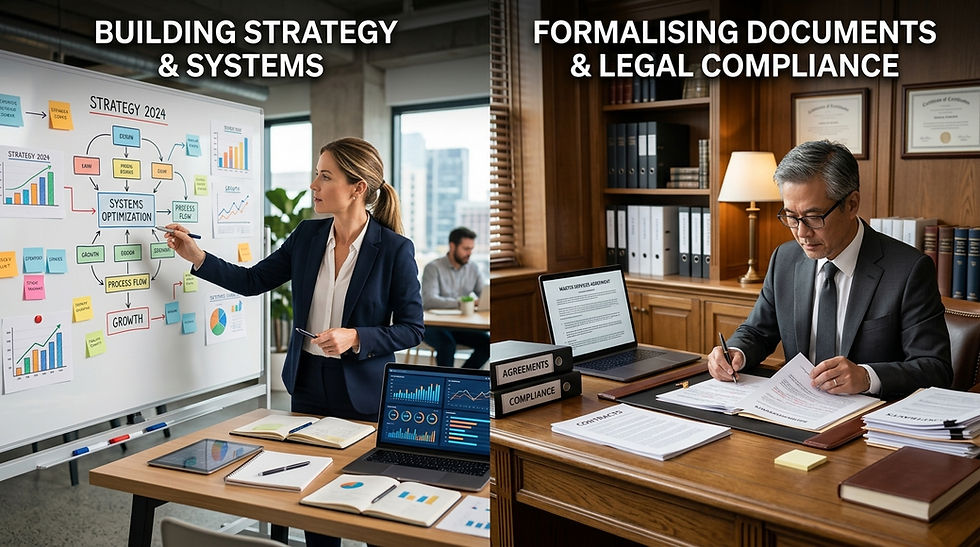
Franchising Is Not A Legal Exercise. It Is An Integrated Commercial System.

Updated: Jun 28
There is one point on which most experienced franchising professionals agree: Franchising is complex.
Any consultant, advisor, accountant or lawyer who suggests otherwise is doing business owners a disservice.
Franchising involves significant investment, commercial risk, legal obligations, operational challenges, recruitment capability, leadership development and long-term commitment.
The real question is not whether franchising is hard or simple.
The real question is whether franchising is primarily a legal exercise.
This is where our philosophy differs.

At Franchising Made Easy®, we believe legal compliance is essential.
However, legal compliance alone does not create a successful franchise system.
A franchise agreement has never recruited a franchisee.
A disclosure document has never improved unit economics.
A trade mark registration has never created a magnetic brand.
And a lawyer, no matter how capable, cannot create operational capability where none exists.
Legal documents are important.
But they are not the business.
They are the framework that records and protects the business.
Today, I have spent much of the day mystery shopping and trawling through websites of businesses purporting to franchise. But when I check their disclosure on the Franchise Disclosure Register, I find no mention of their franchise system. They have legal documents. They are calling themselves a franchise system. But they are clearly not.
Unfortunately, many aspiring franchisors begin their journey at the wrong end of the process.
They start with legal documents.
We believe they should start with commercial reality.
Before a founder spends money on franchise agreements, disclosure documents and legal structures, they should first ask some difficult questions.
Is the business genuinely profitable?
Can it generate a reasonable return for a franchisee?
Can the brand generate significant demand?
Can the operating model be replicated?
Can staff be trained effectively?
Can quality be maintained?
Can support be delivered consistently?
Can the founder transition from being the system to designing the system?
If those questions cannot be answered confidently, the lawyer and the legal documentation become largely irrelevant.
You can legally franchise a poor business model.
Many people have. I have seen it too many times.
The results are rarely positive.
The uncomfortable truth is that most franchise failures are not caused by legal documents. They are caused by commercial weaknesses that existed long before the first franchise agreement was signed.
Weak unit economics.
Founder dependency.
Poor recruitment.
Inadequate systems.
Insufficient capital.
Lack of differentiation.
Operational inconsistency.
These are the issues that destroy franchise networks.
The legal framework simply records them.
That is why we view franchising as an integrated commercial system rather than a legal project.
The legal architecture is one component.
An important component. But only one component.
A successful franchise system requires multiple disciplines working together.
The commercial model must be viable.
The operating systems must be documented.
The brand must be capable of attracting customers and franchisees.
The recruitment process must identify suitable candidates.
The support systems must create capability within franchisees.
The governance structure must maintain standards.
The financial model must create value for both franchisor and franchisee.
And yes, the legal framework must protect all of it.
When these elements align, franchising can become a powerful mechanism for growth and enterprise value creation.
When they do not, no amount of legal drafting can compensate.
This is why we work closely with accountants, marketers, recruitment specialists, intellectual property professionals, finance brokers and stable and experienced franchise lawyers.
Not because any one discipline has all the answers.
But because franchising sits at the intersection of all of them.
And equally, because franchising is an integrated commercial system, founders often require advice from multiple disciplines. Where appropriate, we can refer clients to a panel of suitably experienced professionals, including franchise lawyers, accountants, finance specialists, intellectual property experts and other advisors who understand the practical realities of franchising and business growth.
The objective is not simply to obtain advice, but to ensure that strategy, operations, economics, compliance and governance are aligned from the outset.
The strongest franchise systems are not built by lawyers.
They are not built by consultants.
They are not built by accountants.
They are built when all of those disciplines contribute to a commercially integrated system.
We have enormous respect for specialist franchise lawyers.
In fact, we encourage every client to engage stable and appropriately qualified legal advisors.
The legal consequences of getting franchising wrong can be significant.
But we also recognise another reality.
A legally compliant franchise system can still fail commercially.
And that is where many founders become confused.
Compliance is not the destination.
Compliance is the minimum standard.
Success requires much more.
At Franchising Made Easy®, we believe the objective is not simply to create franchise documents.
The objective is to create a scalable business capable of supporting franchisees, generating sustainable income and building long-term enterprise value.
The legal documents matter.
The lawyers matter.
The accountants matter.
The systems matter.
The recruitment strategy matters.
The economics matter.
The founder matters.
The challenge is not choosing one.
The challenge is integrating them all into a commercially viable franchise system.
Because franchising is not a legal exercise.
It is an integrated commercial system.
And the businesses that understand that distinction are often the ones that build the strongest franchise networks.
Frequently Asked Questions
Is franchising primarily a legal process?
No. While franchising involves significant legal obligations, successful franchise systems are built through the integration of strategy, operations, financial modelling, recruitment, brand development, support systems, governance and legal compliance. Legal documentation is essential, but it is only one component of a much larger commercial framework.
Can a business be legally compliant but still fail as a franchise?
Absolutely. Many franchise systems fail despite having professionally drafted legal documents. Common causes of franchise failure include poor unit economics, founder dependency, weak recruitment processes, inadequate support systems, insufficient capital, poor operational documentation, and lack of market differentiation. Legal compliance is necessary, but it does not guarantee commercial success.
What should a business owner do before franchising their business?
Before considering franchise agreements and disclosure documents, business owners should assess whether their business is genuinely ready for franchising. This includes evaluating profitability, operational systems, replicability, training capability, brand strength, franchisee return on investment, recruitment infrastructure, and long-term scalability. The strongest franchise systems are built on solid commercial foundations before legal documents are prepared.
Why do successful franchise systems require multiple professional advisors?
Franchising sits at the intersection of several specialist disciplines. A franchisor may require input from accountants, finance specialists, recruitment experts, operations consultants, intellectual property professionals, marketing specialists, and franchise lawyers. No single advisor can provide expertise across every area. The objective is to integrate the right expertise into a cohesive franchise system that supports sustainable growth.
What does it mean to be 'ready for franchising'?
Being ready for franchising means more than simply wanting to expand. It means your business has proven profitability, documented systems, a replicable operating model, a defendable brand, sufficient resources, a realistic franchisee economic model, and the leadership capability to support franchisees. Businesses that invest in these foundations are typically far better positioned to create successful franchise networks and long-term enterprise value.
Speak With a Franchise System Architect
If you are exploring franchising and want to determine whether your business may be ready for franchising, understanding the development process is an important first step.
At Franchising Made Easy®, we help founders design franchise systems that are structurally integrated and capable of sustainable growth.
If you would like to explore how franchising could work for your business, consider speaking with an experienced Franchise System Architect.