Why Lawyers Alone Cannot Franchise Your Business

Updated: Jun 28
One of the most common misconceptions in franchising is that hiring a franchising lawyer is the first step to becoming a franchisor.
It isn't.
In fact, for many business owners, it can become one of the most expensive mistakes they make.
The typical sequence looks something like this.
A business owner decides they want to franchise their business.
They engage a franchising lawyer.
Several weeks later they receive a franchise agreement and disclosure document.
They tick "legal documents" off the list and assume they now have a franchise system.
Unfortunately, they don't.
They have legal documents and an invoice.
That's like hiring a conveyancing solicitor, settling on a block of land and believing you now own a completed house.
The legal paperwork may be finished.
The real work has barely begun.

At Franchising Made Easy®, we regularly work alongside experienced and balanced franchising lawyers and consider them an important part of the franchise development process. However, successful franchise systems are not created by lawyers alone.
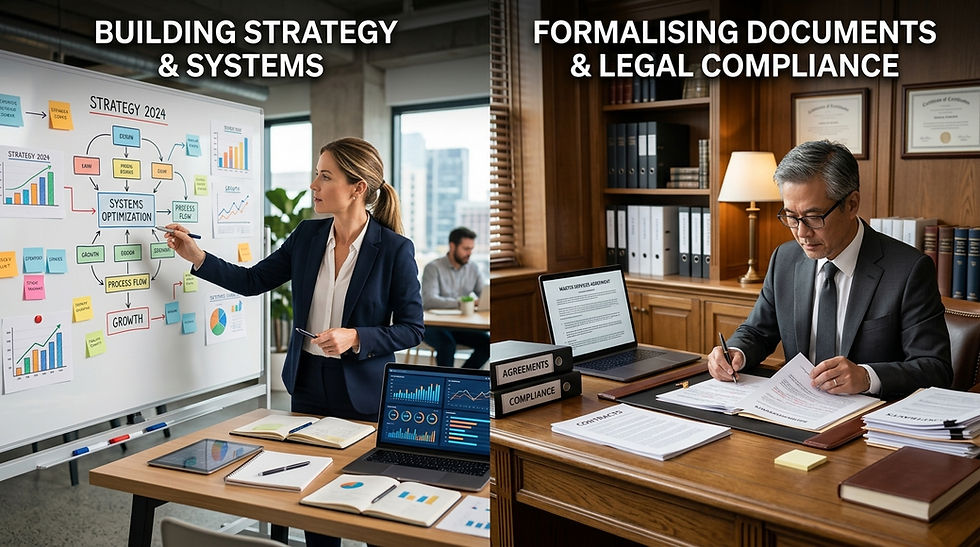
They are built through the alignment of strategy, economics, operations, branding, recruitment, support systems, governance and legal protection.
As we often say:
Legal documents record strategy. They do not create it.
Understanding this distinction can save aspiring franchisors significant time, money and frustration.
The Role of a Franchising Lawyer
Let's be clear.
Experienced and stable franchising lawyers perform an important role.
They help franchisors:
Draft franchise agreements
Prepare disclosure documents
Protect intellectual property
Structure franchise relationships
Explain legal obligations
Assist with compliance requirements
Manage legal risk
Support dispute resolution when necessary
These are critical functions.
However, they are legal functions.
They are not franchise development functions.
A lawyer can document your franchise model.
They cannot create your franchise model.
A lawyer can protect your intellectual property.
They cannot create a compelling brand.
A lawyer can draft obligations.
They cannot create operational excellence.
The distinction matters because many aspiring franchisors unknowingly ask lawyers to solve problems that sit outside the legal profession's area of expertise.
The Most Expensive Mistake Aspiring Franchisors Make
One of the most expensive mistakes aspiring franchisors make is confusing legal documentation with franchise development.
Hiring a franchising lawyer and expecting them to build your franchise system is like hiring a conveyancing solicitor and expecting them to build you a house.
The solicitor plays an important role in the purchase of the land.
However, they are not responsible for the design, engineering, financing, construction, project management, trades, marketing or eventual sale of the property.
Likewise, legal documentation is an essential part of franchising.
However, it is only one component of a much larger commercial project.
The problem is not the lawyer.
The lawyer has delivered exactly what they were engaged to deliver.
The problem arises when the business owner mistakes the paperwork for the system itself.
The consequences can be significant. We discuss these in detail in our FME Case Study Series™ which document many of the recent experiences we have encountered with clients and aspiring franchisors.
We regularly encounter businesses that have spent substantial sums on legal documentation only to discover:
The economics do not support franchising
The systems are not sufficiently mature
The founder remains central to every key decision
The brand lacks market traction
Franchise recruitment is far more difficult than expected
Support systems have not been developed
At that point, the legal documents may be technically correct, but they are documenting a concept that is not yet ready for franchising.
A franchise agreement does not create franchisee profitability.
A disclosure document does not create operational consistency.
Compliance does not create recruitment success.
The legal framework protects and records the system.
The system itself must exist first.
What Actually Creates a Franchise System?
Franchising is often viewed through a legal lens.
At Franchising Made Easy®, we believe it should be viewed through a commercial lens.
A franchise system is not a collection of documents.
It is an integrated commercial system designed to help franchisees replicate a proven business model in order to create value for the franchisor, franchisees and others.
At its core, a successful franchise system typically includes:
A proven business model
Strong unit economics
Replicable systems and processes
A service excellence operating system
A compelling brand and a marketing engine
Intellectual property protection
Strategic recruitment systems and processes
Onboarding and training programs
Ongoing support structures
Performance management systems
Governance frameworks
Legal documentation
Notice that legal documentation appears at the end of that list, not the beginning.
That does not make it less important.
It simply recognises its role.
Legal documentation protects and records the commercial structure that has already been designed.
The Six Franchising Success Criteria™ Should Be Assessed Before Legal Drafting Begins
1. Industry Segment Passion & Experience
Franchising is not a shortcut around industry experience.
Founders who deeply understand their industry are typically better equipped to support franchisees, identify risks and respond to changing market conditions.
Before legal documentation is prepared, aspiring franchisors should ask whether they possess the depth of experience and long-term passion necessary to lead a franchise network.
2. Start-Up Graduation
Many businesses attempt to franchise too early.
A business that is still heavily dependent on the founder, lacks mature systems or has not yet demonstrated operational consistency may not be ready for franchising. Having a stable foundation and a clear business direction are traits of a business through its teething stages.
A franchise agreement cannot compensate for a business that has not yet graduated from the start-up phase.
3. Net Profit After Tax (NPAT)
One of the most important indicators of franchising potential is profitability.
If the underlying business struggles to generate sustainable profits, franchising may simply replicate financial problems across multiple locations.
Franchise systems should be built on profitable foundations.
4. Franchisor Mindset
Running a business and leading a franchise network require different capabilities.
The founder must transition from operator to leader, coach, mentor and steward of the brand.
This mindset shift is often underestimated.
5. Business Model Replication
Franchising requires replication not just of systems, but of values, customer service consistency and brand delivery.
If success depends entirely on the founder's personality, relationships or unique skills, the model may not yet be suitable for franchising.
Systems must be capable of producing consistent outcomes when applied by others.
6. Create a Magnetic Brand
A franchise system requires more than operational capability.
It requires a brand that attracts customers, franchisees, employees and strategic partners.
Strong brands create momentum and generate consistent demand.
Weak brands create friction.
Only after these six success criteria have been properly assessed should significant investment be made in legal documentation.
Otherwise, business owners risk documenting a concept that has not yet demonstrated that it is ready for franchising.
Why Some Franchise Systems Struggle
When franchise systems struggle, founders often look to the legal documentation for answers.
In reality, the issue frequently sits elsewhere.
The agreement may be technically sound.
The disclosure document may be compliant.
The intellectual property may be protected.
Yet the network still struggles.
Why?
Because legal compliance cannot compensate for weaknesses in the underlying commercial model.
Common causes of franchise underperformance include:
Weak franchisee economics
Poor recruitment practices
Inadequate support systems
Lack of operational consistency
Unrealistic growth expectations
Weak brand positioning
Founder dependency
None of these challenges can be solved by simply adding more clauses to a franchise agreement.
This is why franchising should never be approached as a legal project.
It is fundamentally a business and financial model development project.
Franchising Is a Team Sport
Successful franchise systems are rarely built by one individual or one professional adviser.
They are built by teams.
Depending on the circumstances, that team may include:
Stable and experienced franchising lawyers
Intellectual property lawyers
Accountants
Funding specialists
Branding professionals
Marketing specialists
Operations experts
Franchise recruitment professionals
Each specialist contributes something valuable.
The challenge is ensuring those contributions are aligned toward a common objective.
That objective should not simply be growth.
It should be sustainable growth.
Growth that creates value for the franchisor.
Growth that creates opportunity for franchisees.
Growth that increases long-term enterprise value.
Why Franchising Made Easy® Starts Before the Lawyers
At Franchising Made Easy®, we are strong advocates for engaging experienced and stable franchising lawyers.
However, we also recognise that legal drafting is only one stage of the journey.
A misguided approach within the franchising industry is to begin with legal documentation and work out the franchise structure later.
Unfortunately, this sequence often creates problems.
The reason is simple.
Lawyers document decisions.
They do not make them.
Before legal documentation begins, we encourage business owners to consider a broader range of commercial questions.
Is the business genuinely ready for franchising?
Are the economics sustainable?
Can the model be replicated?
Are the systems mature enough?
Is the brand strong enough?
Can franchisees succeed?
Can the founder support network growth?
These are franchise development questions.
Only after those questions have been explored does legal documentation become truly valuable.
At that point, the lawyer is documenting a commercial structure that has been carefully considered rather than attempting to create one from scratch.
The Franchising Made Easy® Perspective
At Franchising Made Easy®, we believe in structure before scale.
Because growth without structure creates complexity.
Growth with structure creates enterprise value.
Franchising lawyers play a critical role in franchise development.
Their expertise helps protect brands, manage risk and establish the legal framework that supports a franchise network.
However, lawyers alone cannot franchise your business.
A franchise agreement does not create a franchise system.
A disclosure document does not create a franchise system.
Legal compliance does not create a franchise system.
Those things protect and record a franchise system.
The system itself must exist first.
That is why the most successful franchisors focus on building the system first and documenting it second.
Because legal documents record strategy.
They do not create it.
A franchise agreement is not the destination.
It is simply one milestone in a much larger journey.
Frequently Asked Questions
Can a lawyer franchise my business?
A stable and experienced lawyer can assist with legal documentation, compliance requirements, intellectual property protection and franchise agreements. However, franchise development also requires strategy, operations, economics, branding and marketing, recruitment and support systems that sit outside the legal profession's expertise.
Do I need a franchising lawyer before franchising my business?
Yes, specialist legal advice is an important part of the process. However, business owners should also consider broader franchise development factors such as profitability, systems, recruitment and scalability before investing heavily in legal documentation.
What is the difference between franchise development and franchise law?
Franchise law focuses on legal compliance, agreements, disclosure documents and risk management. Franchise development focuses on designing a commercially viable and scalable franchise system.
Why isn't a franchise agreement enough?
A franchise agreement documents the legal relationship between franchisor and franchisee. It does not create profitability, operational systems, training programs, recruitment strategies or support frameworks.
How do I know if my business is ready for franchising?
A business may be ready for franchising if it has a proven business model, sustainable profitability, replicable systems, protected intellectual property and the ability to support franchisees effectively.
What role does Franchising Made Easy® play in franchise development?
Franchising Made Easy® helps business owners evaluate whether their business may be ready for franchising and assists with the design of commercially sustainable franchise systems. Where appropriate, we can also refer clients to suitably experienced professionals, including franchising lawyers and other specialists.
Speak With a Franchise System Architect
If you are exploring franchising and want to determine whether your business may be ready for franchising, understanding the development process is an important first step.
At Franchising Made Easy®, we help founders design franchise systems that are structurally integrated and capable of sustainable growth.
If you would like to explore how franchising could work for your business, consider speaking with an experienced Franchise System Architect.