Why Big Pizza Brands Are Shutting Stores in 2026 And the Franchise Lessons Hiding Behind the Headlines
- Barry Money

- 1 day ago
- 4 min read
The global pizza sector is entering 2026 with a clear message: Scale alone no longer guarantees stability.
Major pizza brands are closing hundreds of underperforming restaurants, restructuring franchise networks and reassessing long-term growth strategies. While the headlines focus on store closures, the real story is about rising operating costs, changing consumer behaviour and franchise systems under pressure to adapt.
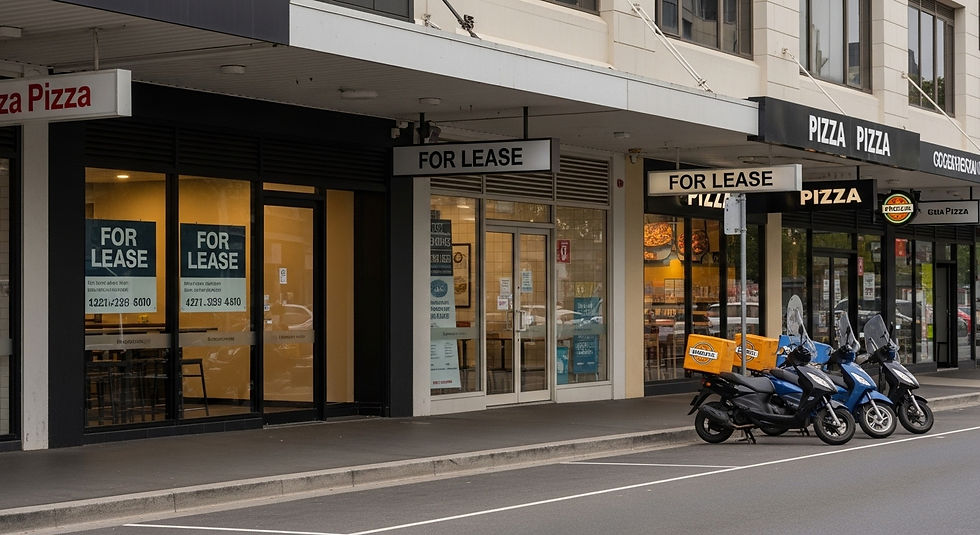
For Australian franchisors, franchisees and investors, these developments offer valuable lessons, even when the closures are occurring offshore.
A global pizza slowdown is accelerating
Over the past two years, pizza chains have faced a convergence of economic headwinds:
Escalating labour costs
Rising food and ingredient prices
Higher rent and tighter retail leasing conditions
Intensified competition from delivery platforms and fast-casual alternatives
These pressures have pushed some brands into restructuring, forced others into bankruptcy, and prompted large networks to rationalise their footprints.
Seattle-based MOD Pizza, once operating around 500 stores, has steadily reduced its network following financial difficulties and a sale of assets. Smaller pizza chains have filed for Chapter 11 protection, while even major franchise operators for well-known brands have struggled to remain solvent.
The message is consistent: Underperforming stores are being culled faster, and franchise systems are becoming less tolerant of marginal locations.
Pizza Hut’s 250-store closure plan
The most notable announcement comes from Pizza Hut’s parent company, Yum! Brands.
Pizza Hut will close approximately 250 underperforming restaurants in the first half of 2026, following a decline in U.S. same-store sales through the fourth quarter and across the full 2025 year, even as international same-store sales grew. The closures form part of Pizza Hut’s broader “Hut Forward” strategy.
Importantly, this is not a retreat from franchising or global growth. During 2025 alone, Pizza Hut opened nearly 1,200 new locations across 65 countries, including strong international performance in the Middle East, Latin America and Asia.
Instead, the closures reflect a strategic shift: Fewer weak sites, tighter operational standards, and a stronger focus on profitability rather than raw store count.
What is the “Hut Forward” strategy really about?
According to Yum! Brands, Hut Forward includes:
Refreshed marketing initiatives with targeted financial support
Modernisation of technology platforms
Updates to franchise agreements
Deliberate closure of underperforming units
From a franchising perspective, this highlights a critical point: Franchise agreements and network structures are not static documents. They must evolve with market conditions, cost pressures and consumer behaviour.
For franchisees, it also reinforces the reality that continued operation depends not just on brand strength, but on location economics, cost control and alignment with system-wide strategy.
Bankruptcy filings show the pressure on franchisees
Several high-profile pizza franchise operators filed for bankruptcy protection in 2025, including operators of Domino’s and Little Caesars stores in the United States.
These cases underscore a recurring issue in franchising: Brand success does not always translate into franchisee profitability. When labour costs, rents and supply prices rise faster than revenue, even established operators can become financially distressed.
In Australia, where minimum wages, penalty rates and retail leasing costs are already high, the same structural risks exist, particularly for food-based franchise systems with thin margins.
Why this matters for Australian franchise systems
Although these closures are occurring primarily in the United States, the lessons are directly relevant to Australia’s franchising landscape.
Key takeaways include:
Network quality matters more than network size
Aggressive expansion without rigorous site selection can weaken a brand over time.
Lease structures can make or break franchise viability
Long leases with inflexible rent increases magnify risk during economic downturns.
Franchise agreements must allow strategic adaptation
Outdated agreements can prevent franchisors from modernising operations or exiting unviable locations.
Franchisee sustainability is a system risk
Widespread franchisee distress eventually impacts brand value, reputation and growth prospects.
Strategic reviews are becoming the norm
Yum! Brands has confirmed that Pizza Hut is currently undergoing a strategic review, with outcomes expected in 2026. Strategic reviews are increasingly common across global franchise brands as they reassess:
Store formats
Delivery versus dine-in models
Franchise fee structures
Support obligations
Long-term network composition
For emerging Australian franchisors, this reinforces the importance of building flexibility into franchise models from day one, particularly in franchise agreements, disclosure documents and operational manuals.
Final thoughts
The wave of pizza store closures is not a signal that franchising is failing. It is a signal that franchising is maturing under economic pressure.
Brands that actively review performance, close weak locations and modernise their systems are positioning themselves for long-term resilience. Those that ignore structural issues risk franchisee burnout, legal disputes and reputational damage.
For anyone involved in franchising, whether launching a new system or operating within an established one, the message is clear: growth must be strategic, sustainable and commercially realistic.
At Franchising Made Easy®, we see these global developments as timely reminders that strong franchise systems are built on clarity, adaptability and sound commercial foundations, not just brand recognition or a pile of legal documents.
Speak With a Franchise System Architect
If you are exploring franchising and want to determine whether your business may be ready for franchising, understanding the development process is an important first step.
At Franchising Made Easy®, we help founders design franchise systems that are structurally integrated and capable of sustainable growth.
If you would like to explore how franchising could work for your business, consider speaking with an experienced Franchise System Architect.