Why Every Franchise System Needs a Second Brain
- Barry Money

- 1 day ago
- 5 min read
I was sitting in a franchise development workshop recently with a client who is preparing their business for expansion.
We were discussing operations manuals, playbooks, training systems and the hundreds of moving parts that sit behind a scalable franchise network. At some point the conversation shifted towards AI, knowledge management and the growing number of tools now available to businesses.
That wasn't the interesting part.
What interested me was the problem we were actually trying to solve.
Because beneath every conversation about AI sits a much older challenge. In fact, it is one of the oldest challenges in business.
How do you stop critical knowledge leaving when people do?
Every growing business eventually runs into this problem.
The founder knows things.
The operations manager knows things.
The long-serving employee knows things.
Over time, these people accumulate thousands of small lessons, observations and experiences that allow the business to function effectively. They learn how to handle difficult customers. They know which suppliers can be trusted. They understand which numbers matter and which don't. They develop instincts that help them identify problems before those problems become serious.
The challenge is that most of this knowledge never gets documented.
It remains trapped inside people.
At a single site, that might not matter too much. The founder is there. The manager is there. The team can walk across the room and ask a question.
But franchising changes everything.
The moment you begin replicating a business, knowledge transfer becomes one of the most important strategic challenges you will face.
Many founders assume the answer is an operations manual.
Certainly, an operations manual is important. Every franchise system needs one. But after more than two decades working with businesses and franchise networks, I have become convinced that most people dramatically overestimate what a traditional operations manual actually achieves.
An operations manual tells people what to do.
It does not necessarily tell them what to think.
That distinction becomes incredibly important as a network grows.
Imagine a franchisee encounters a customer complaint they have never seen before. The answer may technically exist somewhere in the system. It may be buried inside a training guide, hidden in a procedure manual, mentioned in an email from three years ago, or sitting inside the head of an experienced manager.
The information exists.
The challenge is finding it.
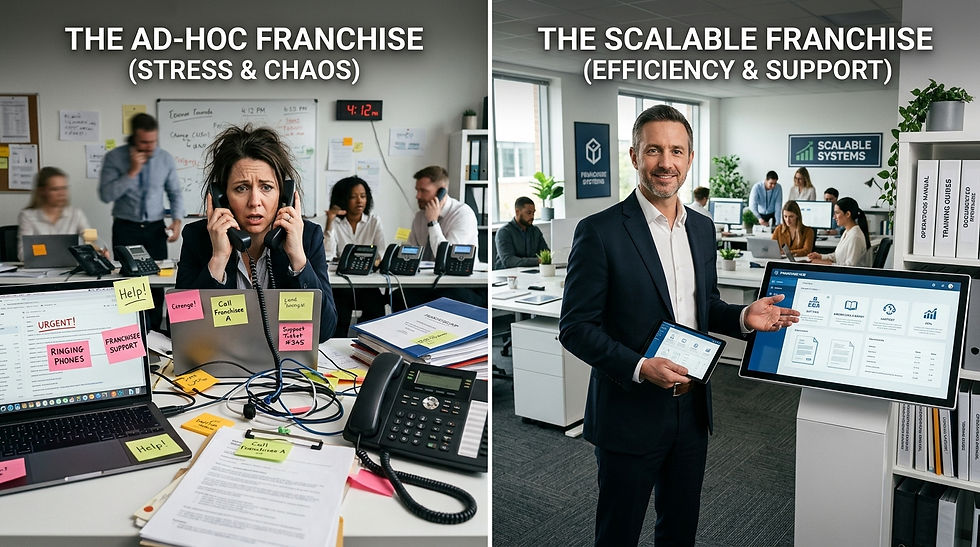
This is where many franchise systems begin to struggle. They accumulate enormous volumes of information but very little accessible intelligence.
The founder still becomes the answer to every difficult question.
The operations team still becomes the help desk.
The network grows, but the dependency remains.
Five franchisees become ten. Ten become twenty. Twenty become forty.
The questions multiply.
The founder's capacity does not.
What looked manageable at three locations becomes unsustainable at thirty.
This is one of the reasons so many franchise systems plateau. It is not because the business model is broken. It is because the knowledge transfer system never matured.
The founder accidentally became the franchise support department.
What struck me during the recent workshop was that we were not really discussing technology at all. We were discussing organisational memory.
How does a business remember what it has learned?
How does it capture years of experience and make that experience available to the next person who needs it?
Historically, businesses attempted to solve this through manuals, filing cabinets, shared drives, intranets and training folders. Most of us have seen the result. Information gets stored. More information gets added. Eventually nobody knows where anything is, and people stop looking.
The business has knowledge.
The business just can't access it efficiently.
That is why I believe every franchise system eventually needs what I call a second brain.
The first brain will always be people.
Founders, managers, trainers and support teams remain critical. Franchising is still a relationship business. Leadership, coaching, culture and accountability cannot be outsourced to software.
But people alone are not enough.
A second brain is a system that captures, organises and makes knowledge accessible. It stores decisions, lessons learned, operational insights, training material, case studies and practical experience in a way that can be retrieved when needed.
Not to replace people.
To support them.
That distinction is important because there is a lot of nonsense being spoken about AI at the moment. Some people talk as though technology will replace franchise support teams entirely. I do not believe that.
What I do believe is that technology can make good support teams dramatically more effective.
Imagine a franchisee needing guidance on handling a particular operational issue. Instead of waiting for someone to return a phone call, searching through dozens of documents, or hoping the right person is available, they can access approved knowledge instantly. Not because the system is making decisions for them, but because the system remembers what the organisation already knows.
That is a fundamentally different proposition.
It is not about automation.
It is about accessibility.
And accessibility becomes increasingly valuable as networks grow.
There is another reason this matters.
Enterprise value.
Businesses that depend on founders are fragile. Businesses that depend on systems are scalable.
When knowledge remains trapped inside individuals, growth becomes harder, succession becomes harder and eventually exit becomes harder. Buyers do not pay premium valuations because the founder knows all the answers. They pay premium valuations when the business can function consistently without the founder being involved in every important decision.
And let me give you a real example from a business owner who thought his business was worth millions. Eventually he sold for less than $500k because his business lacked systems and the capacity to scale without founder dependency.
That is why knowledge management is not an administrative exercise.
It is an asset creation exercise.
Every lesson captured. Every playbook developed. Every case study documented. Every operational decision recorded. All of it contributes to the long-term value of the business.
Founder Reality Check
Most founders believe they have documented their business because they have an operations manual.
Usually they haven't.
They have documented procedures.
The real knowledge is still sitting inside people.
A genuine franchise system exists when the business can remember what it has learned without relying on a specific individual to be present.
Because the goal is not simply to build a business that works while the founder is there.
The goal is to build a business that continues to think when the founder isn't.
Speak With a Franchise System Architect
If you are exploring franchising and want to determine whether your business may be ready for franchising, understanding the development process is an important first step.
At Franchising Made Easy®, we help founders design franchise systems that are structurally integrated and capable of sustainable growth.
If you would like to explore how franchising could work for your business, consider speaking with an experienced Franchise System Architect.