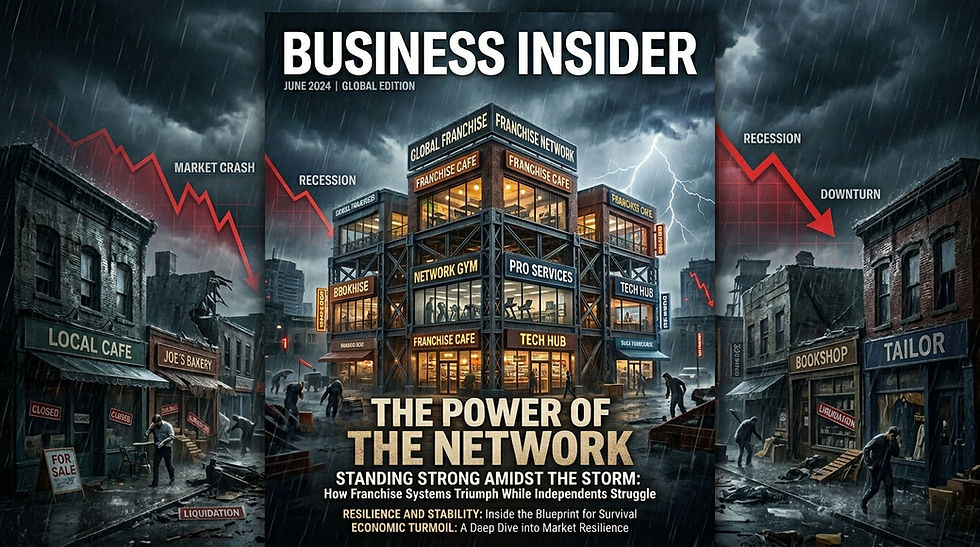
Survive This Downturn. Build a Business That Can Survive the Next One.

Why Australia's economic pressures are exposing independent businesses, and how the foundations of franchising can help build greater resilience.

I tried to take my family out for breakfast the other day, only to discover that two longstanding inner-city cafés I used to frequent had both closed.
I was stunned. But not entirely surprised.
Both had been fixtures in their suburbs for years. I'd first discovered them long ago, and they were the sort of businesses you assumed would always be there.
Initially, I thought perhaps they'd relocated. A quick internet search confirmed both were permanently closed.
When I asked a local what had happened, the explanation was depressingly familiar.
"They couldn't afford the rent and operating costs anymore."
Neither café belonged to a franchise system. Both were independent businesses.
And both had disappeared.
It got me thinking about the pressure facing Australian small businesses, particularly those operating in hospitality, retail and consumer services.
When the economy gets tough, is an independent business at a disadvantage compared with a business operating within a well-managed franchise network?
I believe there are compelling commercial reasons why it can be.
But the bigger question is what independent business owners should be doing about it.
Australia's Cost-of-Living Crisis Has Become a Business Survival Challenge
Australia's economic difficulties aren't simply about inflation.
They're about the cumulative effect of rising costs, weak household purchasing power, high debt and increasingly cautious consumers.
In February 2025, the Reserve Bank reported that Australia had experienced one of the weakest periods of real household disposable income growth since the 1960s. Real disposable income per person was approximately 1% below its pre-pandemic level.
Although incomes subsequently recovered, the RBA reported another decline in real disposable income per person during the first half of 2026.
Meanwhile, Australian household debt remained just under 180% of disposable income.
That's a substantial financial commitment hanging over Australian households.
And the pressure hasn't disappeared.
The Australian Bureau of Statistics reported annual inflation of 4.3% in September 2026, with underlying inflation at 3.6%, still above the Reserve Bank's target.
NAB's September 2026 consumer research found that cost-of-living stress had reached its highest level since 2014.
For business owners, these statistics have practical consequences.
Families eat out less frequently. Customers become more price-conscious. Purchases are postponed. Consumers seek discounts, cheaper alternatives and better value.
Yet the business owner's rent, wages, electricity, insurance and financing costs don't necessarily fall when customer spending weakens.
Revenue comes under pressure while operating costs remain stubbornly high.
That's a dangerous combination.
Business Insolvencies Tell Only Part of the Story
The financial consequences of Australia's difficult economic environment are increasingly visible.
According to ASIC, 14,153 Australian companies entered external administration during 2025–26. Although that was approximately 4% lower than the previous year, insolvencies remained 28% higher than in 2023–24.
Hospitality has been particularly exposed. Accommodation and food services accounted for almost 15% of corporate external administrations in 2025–26.
But formal insolvencies only tell part of the story.
Not every struggling business ends up in liquidation. Some owners simply decide they've had enough and shut up shop.
According to the Australian Bureau of Statistics, 375,331 businesses exited the Australian economy during 2025–26, including 163,429 sole proprietors.
That's nearly 450 sole proprietor exits every day.
Of course, not every exit represents financial failure. Businesses also close because of retirement, restructuring, changes in ownership or personal circumstances.
But the distinction matters.
Corporate insolvency statistics capture businesses entering formal financial distress proceedings. ABS exit figures capture a much broader group of businesses that cease to be recorded as actively trading, including independent operators who simply close their doors.
And behind those numbers are established businesses, lost livelihoods, employees, suppliers and communities affected by their disappearance.
Which brings me back to those two cafés.
They may never have appeared in ASIC's insolvency statistics. But they were certainly no longer serving breakfast.
For independent business owners, the challenge isn't simply avoiding insolvency. It's building a business profitable and resilient enough to remain open when economic conditions deteriorate.
Does Franchising Improve Business Survival?
Here's where the evidence becomes interesting.
Jim's Group, one of Australia's largest franchise networks, publishes information about franchisee retention.
Founder Jim Penman has reported that approximately 88% of new Jim's franchisees remain within the system after their first year.
In his book Every Customer a Fan, Penman also describes how first-year franchisee departures reportedly fell from approximately 17% to around 10–11% following improvements to training.
That's a useful example.
The franchisor identified a weakness, improved its systems and subsequently reported better franchisee retention.
Independent research from the United States provides a more measured perspective.
A study by Lafontaine and colleagues, using US Census Bureau data, found that franchised establishments generally enjoyed a modest initial survival advantage over independent businesses.
However, that advantage largely disappeared after the first year or two.
So let's be clear.
Franchising doesn't guarantee business survival.
But the research and the Jim's example suggest that the quality of the franchise system, its training and its support infrastructure can make a difference.
And that brings us to the commercial advantages of scale.
The Independent Operator Has to Do Almost Everything Alone
Consider the owner of a single café.
They negotiate their own purchasing arrangements, recruit employees, manage rosters and associated headaches, develop marketing campaigns, maintain equipment, monitor profitability and respond to changing customer behaviour.
When costs rise, they must find the savings.
When customers disappear, they must develop the marketing response.
When technology changes, they must fund the investment.
And when something goes wrong, they often have nobody to turn to except themselves.
Now consider a well-managed franchise network operating 50 or even 20 locations.
The franchisor may negotiate collective purchasing arrangements, coordinate marketing campaigns, provide operational support, benchmark performance and invest in technology that individual operators couldn't economically justify.
A marketing fund can pool resources to support brand-building and coordinated campaigns, subject to its legal obligations and proper governance.
One franchised location discovers a better way to manage labour costs. Another identifies a successful product innovation. A third develops a marketing initiative that attracts new customers.
The franchisor can evaluate those improvements and introduce successful ideas throughout the network.
Instead of 50 businesses independently solving the same problem, the network can develop a solution and share it 50 times.
That's a substantial advantage when margins are under pressure.
Scale Doesn't Eliminate Risk. It Changes Your Ability to Respond.
There's an important qualification.
A poorly designed franchise system can actually make financial problems worse.
Franchisees must pay royalties and other fees. If the underlying business model is weak, those additional obligations can compound financial pressure.
A franchisor without sufficient resources, operational capability or commercial discipline may offer little meaningful support.
That's why franchise development must begin with sound economics.
The franchisee needs a realistic opportunity to earn a sustainable return after meeting operating costs, royalties and other franchise obligations.
The franchisor must generate sufficient revenue to fund the infrastructure, training, technology, marketing and support required by the network.
And the business model must be capable of replication without relying on the founder's constant intervention.
Franchising multiplies whatever you've built. If the foundations are weak, it multiplies the weaknesses.
Survive This Downturn. Prepare for the Next One.
Which brings me back to those two cafés.
I don't know whether franchising would have saved them. Their rents may have become unsustainable, their margins too thin or their owners simply exhausted.
But I do know this.
If you're an independent business owner, surviving the current economic downturn shouldn't be your only objective.
You should be preparing for the next one.
That means getting serious about the foundations of your business.
Understand your numbers. Know which products and services actually make money. Improve purchasing, labour productivity and operating margins. Document your systems. Strengthen your brand. Reduce the business's dependence on you.
These are the same foundations required to develop a successful franchise system.
And they deliver benefits long before you recruit your first franchisee.
Because franchise development isn't simply about selling franchises. It's about building a business model that can be replicated profitably, supported efficiently and eventually expanded without the founder managing every detail.
Once those foundations are established, franchising can provide something an independent operator often struggles to achieve: Scale.
Greater purchasing power. Shared marketing resources. Better technology. Operational benchmarking. More opportunities to innovate and spread the cost of improvement across multiple locations.
Of course, none of those advantages is guaranteed.
But a well-developed franchise system can give its operators access to resources and capabilities that would be difficult to justify or fund individually.
So don't wait until the economy improves to start strengthening your business.
You don't need to recruit franchisees tomorrow. You may not even be ready for franchising.
Start with the foundations.
Because if you've worked this hard to survive the current downturn, surely you want to be better prepared when the next one arrives.
Survival is the immediate priority. Building a stronger, more scalable business is the next.
And that's precisely where Franchising Made Easy® starts.
Before franchisee number one.
Speak With a Franchise System Architect
If you are exploring franchising and want to determine whether your business is ready for franchising, it helps to speak with someone who understands the structural side of franchise development.
At Franchising Made Easy®, we specialise in helping founders design franchise systems that are commercially viable, operationally disciplined and built for long-term growth.
If you would like to explore your options, consider booking a consultation to discuss your business and expansion ambitions.