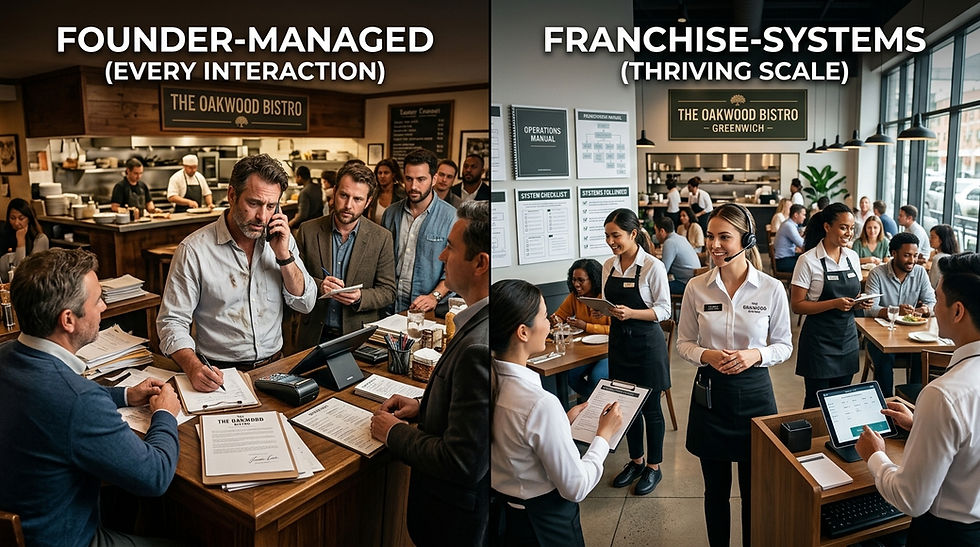
How to Franchise My Business: Lessons From This Week's Client Meetings #2


This Week I Learnt That the Most Valuable Part of a Business Isn't on the Balance Sheet
One of the privileges of my role is spending time each week with founders who are considering franchising their businesses. Every conversation is different, but almost every week a common theme emerges.
This week, it was value.
Not company valuations.
Not EBITDA.
Not profit margins.
Not cash flow.
Those things are important. Every business owner should understand them.
But this week's conversations reminded me that the most valuable part of almost every successful business isn't something you'll ever find on a balance sheet.
It's the knowledge inside the founder's head.
As we worked through the client's expansion strategy, we weren't discussing accounting standards or financial statements. We were discussing how they selected suppliers, why customers remained fiercely loyal, how they dealt with complaints, the little details staff were expected to notice, and the hundreds of decisions they made every day without consciously thinking about them.
At one point I found myself saying something I have said countless times over the years.
"What we're really trying to capture is your institutional knowledge."
The room went quiet.
It was one of those moments when everyone suddenly realised we weren't writing an operations manual.
We were preserving the DNA of the business.
That distinction matters enormously.
When most business owners think about the value of their business, they immediately think about revenue, profit, equipment, vehicles, stock, intellectual property and perhaps the value of the premises.
They're all important assets.
But they're not usually the reason customers keep coming back.
The real value sits somewhere else.
It's found in the thousands of commercial decisions the founder has accumulated over many years.
Which supplier consistently delivers on time.
How much flexibility to give a loyal customer.
When to remake an order without question.
How to identify an exceptional employee during an interview.
How to recover a disappointed customer before they leave a negative review.
How to negotiate with landlords.
How to manage seasonal demand.
How to maintain quality during busy periods.
How to make good decisions when there isn't a written rule.
None of those things appear in the financial statements.
Yet together they often determine whether the business succeeds or fails.
I sometimes ask founders a simple question.
"If someone bought your business tomorrow, what knowledge would disappear when you walked out the door?"
Most pause for a few moments.
Then the answers start flowing.
"I just know which suppliers to trust."
"I can tell when a staff member is about to leave."
"I know which regular customers need extra attention."
"I know when our quality is starting to slip."
"I know which promotions actually work."
Exactly.
That knowledge has enormous value.
The problem is that it usually exists only inside one person's head.
That creates what I call founder dependency.
Founder dependency is one of the biggest barriers to franchising.
If every important decision still depends on the founder's judgement, the business hasn't yet become scalable.
It's still personality driven.
Successful franchise systems don't eliminate founder knowledge.
They convert it into organisational knowledge.
That's a completely different process.
During this week's meeting, we spent hours unpacking things the founders had never consciously documented before.
Not because they were hiding information.
Quite the opposite.
They simply assumed everyone already knew it.
One founder explained how they dealt with a customer complaint.
It sounded straightforward.
As we kept asking "Why?" we discovered there were actually twelve separate judgement calls behind what appeared to be one simple conversation.
The founder wasn't following a written procedure.
They were drawing on years of experience.
That's when I often explain that experience is not yet a franchise system.
Experience becomes valuable when it can be transferred.
Think about that for a moment.
Every successful founder develops instincts.
The challenge isn't developing those instincts.
The challenge is teaching someone else to achieve the same outcome without twenty years of trial and error.
That's where institutional knowledge becomes commercial knowledge.
This is one of the reasons I believe operations manuals are so often misunderstood.
Many people imagine an operations manual is simply a collection of procedures.
Open the store.
Close the store.
Clean the equipment.
Order stock.
Complete a checklist.
Those things belong in a manual.
But they're only part of the story.
The best operations manuals explain not only what to do, but why it matters.
They teach judgement.
They explain standards.
They reinforce culture.
They capture philosophy.
In many respects, they become the founder's voice on paper.
I've often said that a franchise agreement protects a franchise system.
An operations manual creates one.
That's because the manual becomes the mechanism through which institutional knowledge is transferred from one generation of business owners to the next.
Without that knowledge, you're not really selling a business model.
You're selling a logo and hoping for the best.
This week's conversations reinforced another lesson.
Many founders underestimate how much knowledge they actually possess.
They assume everyone thinks the way they do.
They assume everyone notices the same things.
They assume everyone makes the same decisions.
They don't.
That's why documenting knowledge is such a fascinating exercise.
The more questions we ask, the more hidden intellectual property we uncover.
Sometimes it's a customer service philosophy.
Sometimes it's a recruitment process.
Sometimes it's supplier management.
Sometimes it's quality assurance.
Sometimes it's financial discipline.
Piece by piece, we build a commercial blueprint.
Eventually the founders stop saying, "That's just how we've always done it."
Instead they begin saying, "Now I understand why we do it that way."
That's a significant shift.
Because once something can be explained, it can be taught.
Once it can be taught, it can be measured.
Once it can be measured, it can be improved.
And once it can be improved consistently, it can be replicated.
That's the journey from a successful business to a successful franchise system.
It also changes the way founders think about the value of their business.
The value no longer sits solely in today's profit.
It sits in tomorrow's ability to reproduce that profit through other people.
That's why I often describe franchising as the commercialisation of knowledge.
You're not simply expanding locations.
You're expanding certainty.
You're giving another business owner access to years of learning that would otherwise have taken them decades to accumulate.
That's an extraordinary product when you think about it.
The logo isn't the product.
The manual isn't the product.
Even the franchise agreement isn't the product.
The product is accumulated commercial knowledge.
Everything else simply supports its transfer.
As this week's meetings came to an end, I found myself reflecting on how often founders underestimate their greatest asset.
They'll proudly show me new equipment.
They'll talk about revenue growth.
They'll explain their marketing strategy.
Rarely do they appreciate the extraordinary value of what they know.
Yet that's exactly what future franchisees are investing in.
They're buying confidence.
They're buying experience.
They're buying proven judgement.
They're buying a faster path than the founder had.
So if you're wondering how to franchise your business, don't start by asking how many franchisees you could recruit.
Ask yourself a different question.
If someone spent six months working beside you, what would they learn that isn't written down anywhere?
Your answer may well be the most valuable asset your business owns.
Because after another week of client meetings, I was reminded of something that financial statements can never fully capture.
Buildings depreciate.
Equipment wears out.
Technology becomes obsolete.
Even brands evolve over time.
But institutional knowledge, when captured, refined and transferred effectively, becomes an appreciating asset.
It's the foundation of every scalable business.
And in my experience, it's almost always the most valuable part of the business that isn't sitting on the balance sheet.
Thinking about franchising your business?
One of the first things we help founders do is uncover the institutional knowledge they've built over years of operating their business. That knowledge often becomes the foundation of operations manuals, training systems and commercial policies that allow a business to be replicated with confidence. At Franchising Made Easy®, we believe the strongest franchise systems aren't built by documenting procedures. They're built by capturing the thinking, judgement and experience that made the business successful in the first place.
Speak With a Franchise System Architect
If you are exploring franchising and want to determine whether your business is ready for franchising, it helps to speak with someone who understands the structural side of franchise development.
At Franchising Made Easy®, we specialise in helping founders design franchise systems that are commercially viable, operationally disciplined and built for long-term growth.
If you would like to explore your options, consider booking a consultation to discuss your business and expansion ambitions.