
How to Franchise My Business: Lessons From This Week's Client Meetings #1

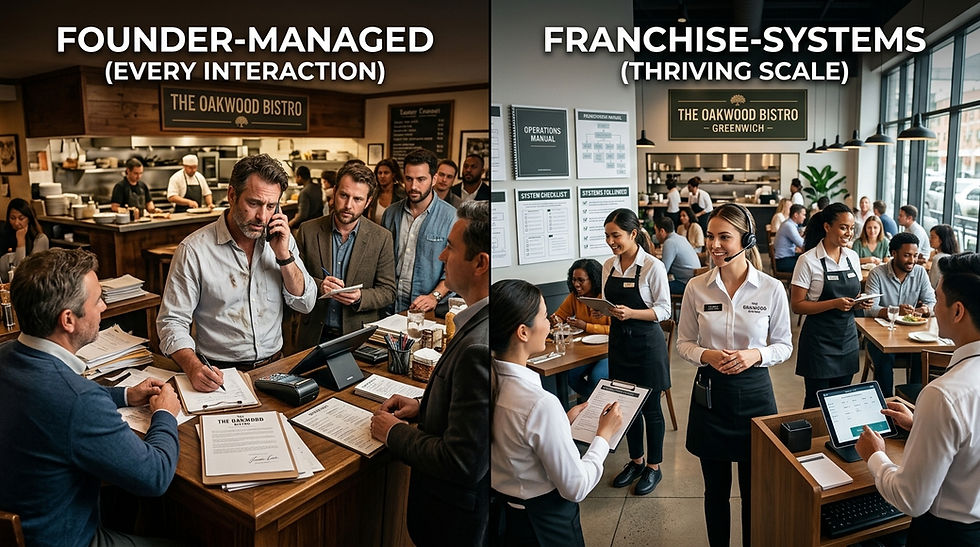
This Week I Was Reminded That Great Customer Service Is a Franchise System, Not a Smile
One of the privileges of my role is spending time each week with founders who are considering franchising their businesses. Every conversation is different, but almost every week a common theme emerges.
This week, it was customer service.
Not customer service in the traditional sense.
Not smiling.
Not greeting customers at the door.
Not asking whether everything was okay with the meal.
Those things matter, of course. But they are only the visible tip of something much larger.
During a strategy session with a hospitality client, we found ourselves discussing the customer experience. As we unpacked what made their business successful, I realised we weren't actually talking about customer service at all.
We were talking about systems.
That conversation reminded me of something I have believed for many years.
Great customer service isn't created by great people. It's created by great systems that allow ordinary people to consistently deliver extraordinary experiences.
It's an important distinction.
Many business owners proudly tell me they have fantastic customer service because they personally know their customers by name. They remember birthdays. They know people's favourite coffee. They can solve complaints on the spot because they've spent years building relationships.
That's wonderful.
But it isn't a franchise system.
It's founder dependency.
If the business relies on one person's personality, memory or instinct, the business hasn't developed customer service. It has developed a talented owner.
There's a world of difference.
When we franchise a business, we aren't trying to clone the founder.
We're trying to replicate the system, including customer experience.
That requires a completely different mindset.
One of the exercises we worked through this week involved mapping every customer touchpoint. Not just inside the café, but before the customer even walked through the door.
How did they discover the business?
What impression did the website create?
How easy was it to book?
What happened if they called?
How were they greeted?
How long did they wait?
What happened if something went wrong?
What happened after they left?
When founders begin thinking this way, something remarkable happens.
They stop seeing customer service as a collection of interactions.
They begin seeing it as a designed system, a continuum.
Every touchpoint becomes intentional.
Every process becomes repeatable.
Every expectation becomes measurable.
That's the point where a business starts becoming ready for franchising.
One of the biggest misconceptions about franchising is that franchisees are buying recipes, products or equipment.
They're not.
They're buying certainty.
They're buying confidence that if they follow the system, customers will receive the same experience every time.
Think about the world's best franchise brands.
Customers don't choose them because every employee is naturally brilliant.
Customers choose them because they know exactly what to expect.
Consistency builds trust.
Trust builds loyalty.
Loyalty builds profitable businesses.
That consistency doesn't happen by accident.
It's designed. It’s a virtuous cycle.
During our discussion this week, we talked about booking confirmations, telephone etiquette, complaint handling, table presentation, greeting customers, online reviews, follow-up emails, loyalty programs and countless other details.
At first glance, they seemed unrelated.
By the end of the workshop, everyone realised they were all connected.
Together, they formed the customer experience.
And because they were documented, measured and continually improved, they became part of the franchise system itself.
I sometimes describe operations manuals as the written version of a founder's best practice and experience.
Customer service is no different.
Most founders don't consciously know why customers keep returning.
They simply do what feels natural.
They welcome people warmly.
They solve problems quickly.
They remember names.
They empower staff.
They notice little things.
Over time, those behaviours become habits.
The challenge is that habits can't be franchised.
Systems can.
That's why one of the most valuable exercises we undertake with new franchisors is asking a deceptively simple question.
"Why do your customers come back?"
The answers are rarely what people expect.
It's almost never because of the logo.
It's rarely because of the advertising.
Often, it isn't even because of the product.
It's because customers feel something.
They feel recognised.
They feel appreciated.
They feel valued.
The challenge then becomes translating those feelings into repeatable business processes.
How do you teach a new franchisee to create that same feeling?
How do you train twenty different teams across twenty different locations?
How do you measure whether it's actually happening?
Now we're no longer talking about customer service.
We're talking about franchise architecture.
This week also reinforced another important lesson.
Customer service is one of the few competitive advantages that competitors can't easily copy.
Anyone can duplicate your menu.
Anyone can copy your pricing.
Anyone can renovate a similar store.
Anyone can purchase similar equipment.
Very few businesses can consistently replicate a remarkable customer experience.
Why?
Because the experience is built from hundreds of small systems working together.
It's how the phone is answered.
It's how complaints are resolved.
It's how new staff are trained.
It's how managers coach their teams.
It's how online reviews are monitored.
It's how quality standards are maintained.
Individually, none of those systems seem particularly revolutionary.
Collectively, they become incredibly powerful.
This is why I often tell founders that customer service isn't a department.
It's the operating system of the business.
Every decision either strengthens or weakens that operating system.
When businesses begin documenting these processes, something interesting happens.
Staff become more confident.
Managers become more consistent.
Customers receive more predictable experiences.
The founder becomes less indispensable.
That's exactly what should happen before franchising.
Too many aspiring franchisors tell me they want franchisees to deliver the same experience they currently provide.
That's a wonderful ambition.
But hope isn't a strategy.
You cannot franchise hope.
You can franchise systems.
That distinction changes everything.
The businesses that scale successfully don't rely on exceptional individuals.
They rely on exceptional processes.
People come and go.
Systems endure.
As we wrapped up this week's meeting, I found myself reflecting on a simple truth.
The founders hadn't asked us to improve their customer service.
They had asked us to help build a franchise system.
Yet by the end of the discussion, everyone realised those two objectives were inseparable.
Because customer service isn't something you add to a franchise system.
It is the franchise system.
Every documented process.
Every training module.
Every checklist.
Every communication standard.
Every complaint procedure.
Every quality audit.
Every follow-up email.
Every operational decision.
Together, they determine how customers experience the brand.
That's what franchisees are really buying.
And that's what customers keep coming back for.
So if you're wondering how to franchise your business, let me leave you with one question.
If you disappeared from your business for six months, would your customers receive exactly the same experience?
Not almost the same.
The same.
If the answer is no, don't worry.
You're not alone.
Most businesses begin there.
The opportunity isn't to work harder.
The opportunity is to capture everything that makes your customer experience exceptional and transform it into systems that other people can confidently follow.
Because this week's client meetings reminded me of something I've seen countless times over the past twenty-five years.
The businesses that build enduring franchise networks aren't necessarily the ones with the biggest marketing budgets or the flashiest fit-outs.
They're the businesses that understand one simple truth.
Great customer service isn't a smile.
It's a system.
Thinking about franchising your business?
One of the first questions we ask isn't about legal documents, franchise fees or territories. It's much simpler: Can your customer experience be consistently replicated by someone else? At Franchising Made Easy®, we help founders capture the systems, standards and institutional knowledge that sit behind exceptional customer experiences, because that's the foundation of every successful franchise network.
Speak With a Franchise System Architect
If you are exploring franchising and want to determine whether your business may be ready for franchising, understanding the development process is an important first step.
At Franchising Made Easy®, we help founders design franchise systems that are structurally integrated and capable of sustainable growth.
If you would like to explore how franchising could work for your business, consider speaking with an experienced Franchise System Architect.


