
Why Great Franchise Systems Are Built Before They Are Needed
- Barry Money

- Jun 25
- 6 min read
Recently I was sitting in a workshop with a founder preparing their business for franchising.
We were working through systems, documentation, compliance requirements and the components needed to support a future franchise network.
At one point the conversation moved toward franchise renewals, renewal fees and franchisee performance warranting renewal.
My aspiring franchisor client asked a reasonable question:
"Why are we talking about franchise renewals? We don't even have franchisees yet."
Fair observation.
A franchise agreement may run for five years. The first franchisee hasn't been recruited. The first renewal is half a decade away.
Why discuss it now?
Well, it forms part of the disclosure process, not to mention return on investment calculations by the franchisee.
But then, I looked at this from a commercial angle and came to the realisation that there was a higher perspective:
Because that is exactly how great franchise systems are built. Not when the problem arrives. Before it arrives.
One of the biggest differences I've observed between businesses that scale successfully and those that constantly struggle is their relationship with the future.
Most businesses react. The best businesses anticipate.
Most businesses solve today's problems. The best businesses build mechanisms that prevent tomorrow's problems.
That distinction sounds subtle. It isn't. It changes everything.
Most Businesses Build For The Business They Have Today
Understandable.
When you're running a business, your attention is drawn to what's immediately in front of you. Customers. Staff. Suppliers. Cash flow. The demands of today are constant and relentless.
So most founders build systems only when forced to.
A reporting process is introduced because information went missing. A procedure is documented because someone made a mistake. A recruitment process is built because a bad hire cost them. A compliance framework is implemented because something went wrong.
Everything reactive. The business learns through pain.
And in fact, I just had a conversation with another client who wants to franchise. They have someone interested in becoming a franchisee and so their reaction is, "How quickly can you help me get legal documents?"
This type of approach gets expensive as you grow. Every problem becomes larger. Every mistake affects more people. Every weakness becomes harder to hide.
Franchising magnifies all of it.
Franchising Is A Magnifying Glass
Franchising has an extraordinary ability to expose reality.
Weak businesses become obvious. Strong businesses become stronger. Systems that worked by accident get tested properly. Processes that depended on the founder get stretched. Assumptions nobody questioned become visible.
Everything becomes bigger, including your problems.
This is why founders who treat franchising as simply another growth strategy often run into serious difficulties. They believe they're replicating success. What they're actually doing is replicating systems. And if those systems are weak, the weaknesses multiply just as fast as the strengths.
The strongest franchise systems are built around anticipating tomorrow's problems, not solving today's.
The Future Arrives Faster Than You Expect
Founders often believe they have plenty of time.
Until suddenly they don't.
"We'll deal with franchise renewals when we have franchisees."
Sounds logical. Until there are twenty franchisees. Then forty. Then sixty.
Now the business is trying to create renewal systems while simultaneously managing a growing network.
The same thing happens with reporting, territory management, compliance, recruitment, training.
The future eventually arrives. The question is whether your business arrives prepared. Many don't, because they assume tomorrow will provide time to solve tomorrow's problems. It usually brings new problems instead.
Building Backwards
This is why I encourage founders to think differently.
Instead of asking "What do we need today?," ask "What will we need when this business reaches forty locations?"
The answers are very different.
At one location, customer complaints go directly to the founder. At forty, this may become the sole focus of the founder. At one location, supplier management lives inside the owner's head. At forty, that's a serious risk. At one location, territory management isn't even a conversation. At forty, it's strategically critical.
The future network forces different thinking, and that thinking changes decisions being made right now.
That's what I mean by building backwards. You start with the destination and work back to the present. The future informs what you build today.
The Franchise Renewal Example
The conversation that prompted this article was about franchise renewals.
On the surface, it felt premature. Through the lens of a future network, it made perfect sense.
Five years from now, agreements approach expiry. Performance reviews need conducting. Renewal notices need issuing. Compliance histories need reviewing. Training obligations need assessing. Commercial decisions need making.
Now imagine building all of that for the first time while simultaneously managing dozens of franchisees.
That is exactly how operational chaos begins.
The smarter approach: Build the framework long before it's needed. When the moment arrives, the mechanism already exists. The system simply activates.
Operators Versus Architects
Many founders are exceptional operators. That's usually why they've succeeded.
They solve problems quickly. Make decisions decisively. Adapt. Get things done.
The challenge is that scaling requires a different capability, architecture.
An operator asks: "How do we solve this problem?"
An architect asks: "How do we prevent this problem from occurring repeatedly?"
I always loved this concept in the Toyota problem solving philosophy. It’s called saihatsuboushi in Japanese, prevention of recurrence.
The operator focuses on execution. The architect focuses on design.
Great franchise systems require both. And this balance is uncomfortable, because the benefits aren't immediately visible.
Nobody congratulates you for creating a renewal process that won't be needed for five years. Nobody celebrates a compliance framework before compliance becomes an issue. Nobody appreciates a territory strategy until territory conflicts emerge.
The value is invisible. Until it isn't.
The Cost Of Waiting
Many businesses delay system development because they see it as unnecessary overhead. Something to do later. Something that can wait.
I believe those systems can’t always wait.
Systems built under pressure are rushed. Processes introduced after problems emerge are reactive. Documentation that follows growth rather than preceding it accumulates inconsistencies.
Every delay creates debt, operational, technical, leadership. That debt must eventually be repaid. Usually at the least convenient moment.
The businesses that scale most effectively invest in infrastructure before the immediate need exists. Not because they enjoy building systems. Because they understand the cost of not building them.
The Infrastructure Nobody Sees
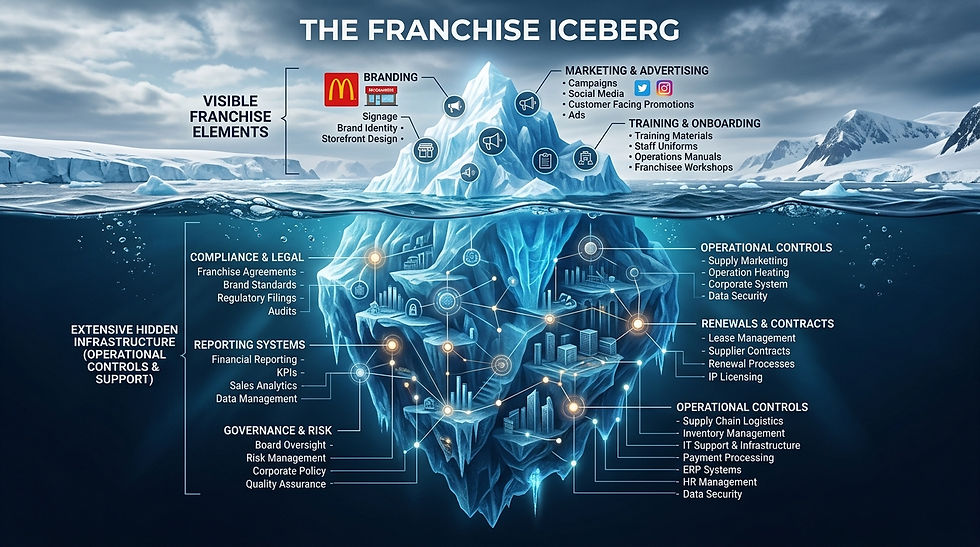
Much of what makes a franchise network strong is infrastructure franchisees never see.
They see the brand, the marketing, the training, the support.
What they don't see is the machinery behind the scenes, reporting systems, compliance frameworks, renewal processes, territory management, document control, performance monitoring, governance structures, operational safeguards
These rarely attract attention. Yet they are often the difference between a network that scales smoothly and one that struggles.
Strong infrastructure creates stability. Weak infrastructure creates dependency.
A Lesson From Mature Franchise Networks
When you examine established franchise systems, one thing becomes clear.
The best networks appear calm.
Problems still occur. Challenges still emerge. But there's a mechanism for dealing with them. The organisation doesn't panic because somebody already thought about the issue. A framework exists. A process exists. A decision-making pathway exists.
This is not accidental. It's the result of years of building systems before they were needed.
The mature network isn't calmer because it experiences fewer problems.
It's calmer because it has already prepared for most of them. That preparation compounds over time.
The Mindset Shift
The most important transition a founder must make is moving from thinking about today's business to thinking about tomorrow's business, from operator to network leader.
The conversation shifts from "What do we need right now?" to "What will future growth require?"
That change in perspective drives better decisions. Better systems. Better documentation. Better governance. Better scalability. And ultimately, better enterprise value.
Businesses that absorb growth predictably are worth more than businesses that depend on heroic effort from their founders.
And I think, folks, that is my punchline. If you intend to move up the wealth generation continuum from owner operator to a wealth-generating franchisor, you need to start thinking in systems.
Reality Check
Most businesses wait until a problem arrives before building a solution. That feels practical. Efficient. Sensible.
Until growth arrives and exposes every weakness that's been deferred.
The strongest franchise systems take a different approach. They build the mechanism before the problem exists. They create the framework before the pressure arrives. They prepare for complexity before complexity appears.
Because they understand a simple truth.
The best franchise systems solve tomorrow's problems before tomorrow arrives.
Frequently Asked Questions
Why plan for franchise renewals before you have franchisees?
Renewal terms form part of the disclosure process and affect a franchisee's return-on-investment calculations from day one.
Isn't it premature to build systems for a network that doesn't exist yet?
No. The operational infrastructure needs to exist before recruitment, not be built reactively once franchisees are already trading.
What's the cost of building systems reactively?
Inconsistent standards and rushed documentation that undermines franchisee confidence and network stability later.
Speak With a Franchise System Architect
If you are exploring franchising and want to determine whether your business may be ready for franchising, understanding the development process is an important first step.
At Franchising Made Easy®, we help founders design franchise systems that are structurally integrated and capable of sustainable growth.
If you would like to explore how franchising could work for your business, consider speaking with an experienced Franchise System Architect.


